
Almost every riverside viewing we run starts with the same question, asked in different words: what happens if the water comes up? It’s the right question, and it deserves a proper answer rather than reassurance for its own sake.
We picked up the British Property Awards 2025 Gold for Staines partly on the back of how we handle exactly this conversation with buyers. It’s the topic that decides more riverside sales than anything else, so it’s worth getting right.
How Does Flood Risk Actually Work on the Thames?
Two things matter most: how high the property sits relative to the water, and which Environment Agency flood zone it falls in. A house raised well above typical water levels, on solid foundations, behaves very differently in a wet winter to one built close to the bank at a low level. Before any viewing goes ahead, we ask how high the property is off the ground and whether flooding would realistically reach the interior, because that single answer shapes everything else: the insurance conversation, the mortgage conversation, and the price.
What Do the Environment Agency’s Flood Zones Actually Mean?
The Environment Agency splits land into three flood zones based on annual flood probability, and it’s worth knowing roughly where a property sits before you fall in love with it. Flood Zone 1 covers land with less than a 0.1% chance of river or sea flooding in any given year, so under 1 in 1,000. Flood Zone 2 covers land with a 0.1% to 1% annual probability from rivers, so somewhere between 1 in 1,000 and 1 in 100. Flood Zone 3 covers anything above a 1% annual probability from rivers, meaning at least 1 in 100 in a typical year. Crucially, these zones are calculated ignoring existing flood defences such as walls, banks or the Thames Barrier, so a property sitting behind a solid flood wall can still show as Zone 3 on the map, because the assessment considers what would happen if that wall failed. It’s not a reason to panic, but it is a reason to ask what the zone actually represents rather than assuming the worst from the label alone.
What Is Flood Re, and Why Doesn’t It Cover Every Home?
Flood Re is the government-backed reinsurance scheme designed to keep flood insurance affordable for homes in higher-risk areas. It works by capping what insurers can charge for the flood element of a policy on eligible properties. The scheme has a firm cutoff, though: homes built from 1 January 2009 onwards are not eligible. That’s a deliberate policy decision. The aim is to discourage further building on floodplains, not an administrative oversight, but it matters enormously if you’re looking at a newer riverside development.
Buyers looking at anything built after 2009 need to go into the purchase with open eyes about what that means for insurance.
What Does Insurance Cost Outside Flood Re?
It’s still possible to insure a post-2009 riverside home. It’s just usually dearer, harder to place with a mainstream insurer, and likely to carry a higher excess than an equivalent policy under Flood Re. Some buyers are surprised by this the first time they get quotes; it’s worth building the higher premium into your budget from the start rather than treating it as a shock at renewal.
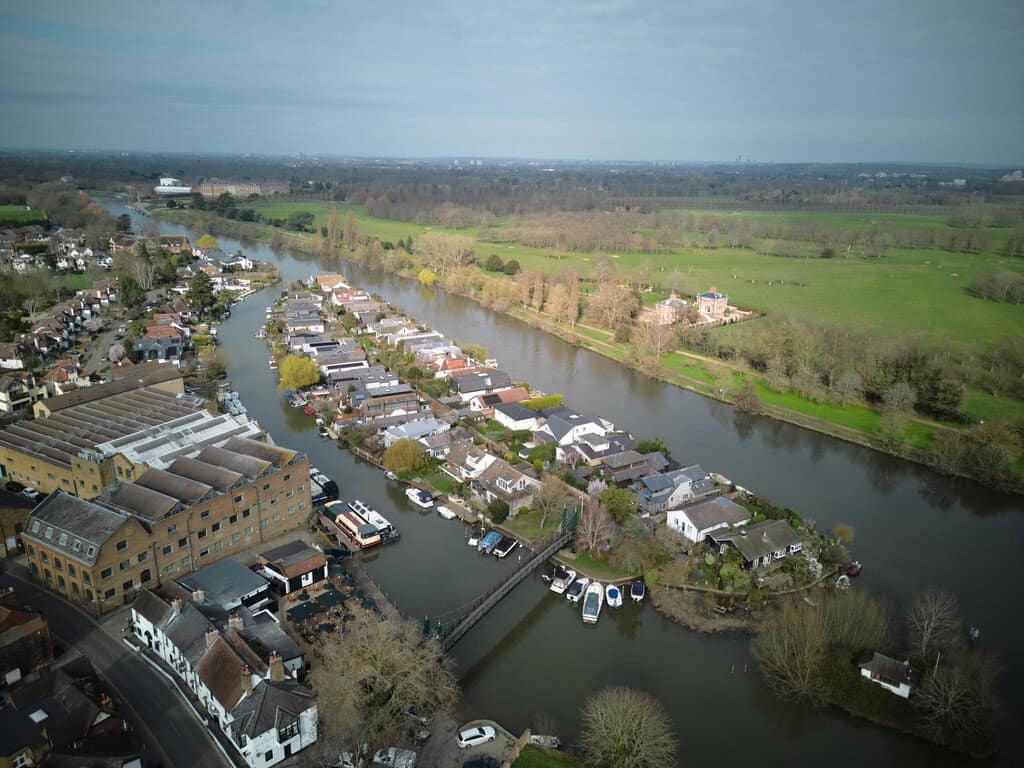
In 2014, our own family home on one of the Shepperton islands flooded, along with a good number of others along that stretch of the Thames. We spent the following year rebuilding it and stayed for many years afterwards, because for all the disruption that year caused, the river remains a genuinely wonderful place to live — we live on it still today, in Staines. That experience is a large part of why we push buyers to ask the insurance question early rather than assuming it will sort itself out at completion.
How Does Flood Risk Affect Getting a Mortgage?
Construction type matters here as much as flood zone. Timber-built riverside homes can be harder to raise mortgage funds against than brick, simply because some lenders treat timber construction as non-standard. Wall thickness matters too. A number of older river properties are still single-skin, which again narrows the pool of lenders willing to offer a standard mortgage. None of this makes a purchase impossible, but it does mean a buyer’s mortgage broker needs to know the construction details before an application goes in, not after a valuation comes back with conditions attached.
How Can Buyers Reduce Flood Risk in Practice?
A sensible pre-purchase routine covers a handful of practical steps:
- Get a proper survey that specifically addresses flood history and construction type, not just general condition.
- Ask the seller directly whether the property has flooded before, and when.
- Check what flood defences or resilient fittings are already in place, such as raised electrics, non-return valves on drains, or flood barriers for doors.
- Use a solicitor who understands riparian rights and river-specific conveyancing, since flood history and mooring ownership often surface together during due diligence.
None of these steps guarantee a smooth purchase, but skipping them tends to surface problems later rather than earlier, usually at the worst possible point in a chain. A buyer who asks these questions before making an offer is in a far stronger position to negotiate than one who discovers the answers after a survey comes back with conditions attached.
Why Do Riverside Homes Still Sell Well Despite All This?
Because for the right buyer, the setting outweighs the friction. We see it in the numbers as much as in conversation: Staines-upon-Thames alone had an average sold price of around £478,000 in 2026, with detached homes averaging closer to £692,000, and prices in the TW18 4 postcode up roughly 5% year-on-year. Riverside demand hasn’t softened because of flood risk; it’s simply better understood by buyers who do their homework first.
If you’re considering selling a riverside property and want a valuation that accounts properly for flood zone, construction and insurance position, book a valuation with us. We cover Shepperton, Wraysbury and the wider Thames-side patch, and our broader guide to living on the River Thames is a good starting point if you’re still weighing up whether river life suits you at all.
Frequently asked questions
Which homes are excluded from Flood Re?
Homes built from 1 January 2009 onwards are not eligible for Flood Re. This is a deliberate policy to discourage new building on floodplains, not an oversight.
Can you still insure a riverside home if it isn’t covered by Flood Re?
Yes, insurance is still available outside the Flood Re scheme, but it tends to be more expensive, harder to source from a mainstream insurer, and comes with a higher excess.
Is it harder to get a mortgage on a timber-built riverside house?
It can be. Some lenders treat timber construction, and older single-skin brick walls, as non-standard, which narrows the pool of lenders willing to offer a standard mortgage.
Do riverside homes still sell well despite flood risk?
Yes. Demand for riverside property in areas like Staines-upon-Thames has remained strong, with prices rising year-on-year, as buyers who understand the flood and insurance position still see clear value in the lifestyle.
About the author
Robert King has spent 41 years in the property industry, most of it working with buyers and sellers in Surrey – Staines and Shepperton – and the surrounding Thames villages. He spent many years living on one of the Shepperton islands with his family, and now lives on the river in Staines. With a passion for water living, he holds an ICC (International Certificate of Competence) for driving leisure craft. Get in touch on 01784 557898 or info@absolute-homes.co.uk.