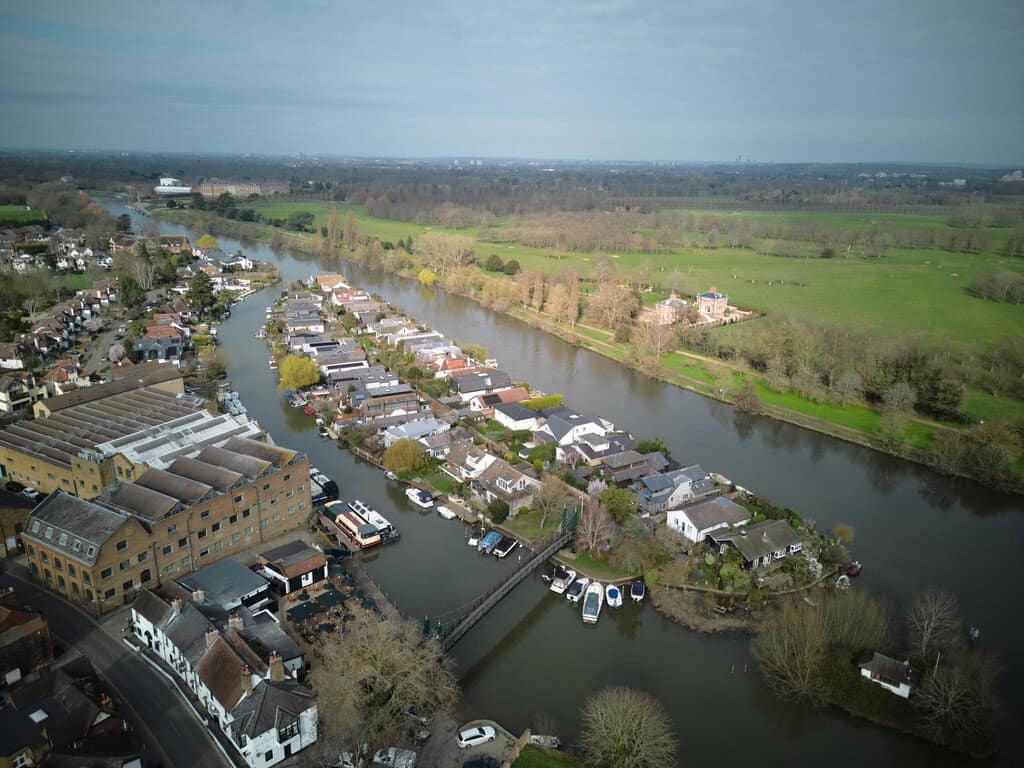

A sale on one of the Shepperton islands stalled for six weeks last year over a single question: who actually owned the riverbed running past the bottom of the garden. The buyer’s solicitor had never handled a riparian property before and didn’t know where to look. It’s a common gap, and it’s worth understanding before you’re the one relying on someone to fill it. This is general guidance, not legal advice; for anything specific to your own property, you’ll need a solicitor to confirm the position on your title.
What Are Riparian Rights, in Plain English?
If a property’s land runs alongside a natural watercourse (the Thames itself, a backwater, a stream or a ditch), the owner is a “riparian owner,” and a set of rights and duties attach to that land automatically, without ever being mentioned in the title deeds. Ownership is generally presumed to extend to the midpoint of the watercourse, under a long-standing common law principle, unless the title deeds say otherwise. That presumption matters more than most buyers expect: it can affect who is responsible for a mooring post, a section of bank, or even a small island that sits on one side of the channel.
Riparian owners also hold the right to receive water in its natural quantity and quality, the right to fish their stretch with a valid rod licence (fishing rights are sometimes sold or leased separately, so this isn’t automatic), and the right to take reasonable steps to protect their land from flooding and erosion, provided any works are agreed with the relevant flood authority first. There’s also a right to abstract a modest amount of water, up to 20 cubic metres a day, for ordinary domestic use without needing a separate abstraction licence, though anything beyond that threshold needs one.
How Do Riparian Rights Interact With a Mooring?
This is where the subject stops being theoretical for most riverside and floating-home buyers. A mooring agreement and riparian ownership are two separate things, and conflating them is a common and costly mistake. Riparian rights belong to whoever owns the land or riverbed; a mooring agreement is a separate, personal arrangement between a boat owner and whoever controls the mooring, whether that’s a riparian landowner, a marina, or a local authority. A buyer can own riparian rights over a stretch of bank without automatically having any right to moor a boat there, and conversely, a mooring holder doesn’t gain riparian rights just by holding a long-standing mooring. Sorting out which applies, and who actually controls what, is exactly the kind of detail a generalist solicitor is most likely to gloss over.
What Duties Come With Riparian Ownership?
Rights come paired with responsibilities. A riparian owner must let water flow through their land without obstruction, pollution or diversion that would affect neighbours upstream or downstream. They’re expected to keep their stretch of bank and any culverts reasonably clear of debris, and they must accept flood flows onto their land even where those flows are caused by inadequate capacity further downstream. There’s no legal obligation to improve the drainage capacity of a watercourse you own, but there is an obligation not to make things worse for anyone else.
Why Do Riparian Rights Matter So Much on a Sale?
Because they touch almost everything that makes a river property valuable: the mooring, the bankside, and the access. A mooring post technically sitting on a riparian owner’s land, rather than on land that transfers automatically with a boat, can turn into a dispute at exactly the wrong moment in a sale. Bankside maintenance obligations can surface as a condition a buyer’s lender wants addressed. And where a property’s boundary runs to the midpoint of the river, working out exactly what’s included in a sale takes more care than a standard suburban boundary ever does.
Why Do Generalist Conveyancers Stumble on This?
Riparian rights arise by common law rather than by anything recorded in the Land Registry, so a solicitor who doesn’t handle river property regularly can simply miss that they apply at all. It’s an easy thing to overlook once, and an expensive thing to overlook on a six-figure sale. We’ve seen sales delayed by weeks while a solicitor who’d never encountered the issue before had to bring in specialist advice partway through, advice that a riverside-specialist firm would have applied from day one. The cost of getting it wrong tends to fall on whoever’s least prepared for it, usually the buyer, at the point in a transaction when nobody wants a delay.
What Should You Ask a Solicitor Before Instructing Them?
- Have you acted on a riparian property sale or purchase in the last twelve months?
- Do you know whether this property’s title extends to the midpoint of the watercourse, or whether that’s been separately conveyed?
- Will you check for any historic mooring agreements, fishing rights or bankside maintenance obligations attached to the property?
- How do you typically handle a riparian issue that surfaces partway through a sale?
A confident, specific answer to each of these is a good sign, ideally backed up with an example of a similar transaction they’ve handled. A vague answer, or a solicitor who hasn’t heard the term before, is a reason to look elsewhere.
How Do We Handle This on Riverside Sales?
We flag riparian status on every river, island and mooring-adjacent property before it goes to market, and we point buyers and sellers toward solicitors we know handle this well, rather than leaving it to chance. As members of The Property Ombudsman and Client Money Protect, we also make sure the wider transaction carries the same protections a standard house sale would, on top of the river-specific advice. It’s covered in more depth, alongside mooring and access questions, in our guides to island living and buying a floating home.
If you’re buying, selling, or simply want to understand the riparian position on a property you already own, get in touch with us and we’ll point you in the right direction, including toward a solicitor who won’t be caught out. Our broader guide to living on the River Thames is a good starting point if you’re still weighing up river property generally.
Frequently asked questions
What are riparian rights in the UK?
Riparian rights are the rights and duties that automatically attach to land bordering a natural watercourse, such as the Thames. They typically include a presumption of ownership to the midpoint of the watercourse, the right to receive water in its natural state, fishing rights with a valid licence, and duties to maintain flow and accept flood water.
Do riparian rights appear in the title deeds?
Not usually. Riparian rights arise automatically from common law rather than being recorded on the title, which is why they’re easy for a solicitor unfamiliar with river property to overlook.
Why do riparian rights matter when buying a river property?
They can affect who owns a mooring post, who’s responsible for bank maintenance, and exactly where a property’s legal boundary sits when it runs to the middle of a watercourse, all of which can affect a sale if not checked properly.
Should I use a specialist solicitor for a riverside property purchase?
It’s strongly advisable. A solicitor who regularly handles riparian property is far less likely to miss issues around mooring rights, bankside obligations or boundary position than a generalist conveyancer.
About the author
Robert King has spent 41 years in the property industry, most of it working with buyers and sellers in Surrey – Staines and Shepperton – and the surrounding Thames villages. He spent many years living on one of the Shepperton islands with his family, and now lives on the river in Staines. With a passion for water living, he holds an ICC (International Certificate of Competence) for driving leisure craft. Get in touch on 01784 557898 or info@absolute-homes.co.uk.