
Most buyers assume finding a boat is the hard part of floating-home life. It rarely is. The hard part, almost every time, is finding somewhere legal to put it, and it’s the question we get asked more than any other by people who’ve only just started looking.
Why Are Residential Moorings the Real Bottleneck?
Canal & River Trust recorded its highest number of new boat licence applications on record in both 2024 and 2025, and that demand has landed on a supply of residential moorings that simply hasn’t grown to match it. Marinas have limited berths, private landowner moorings are finite by definition, and planning restrictions mean new residential mooring sites aren’t appearing quickly. The result is a genuine bottleneck: buyers who’ve found the right boat but nowhere legitimate to keep it. It’s not unusual for us to hear from a client who’s already put down a deposit on a boat before realising there’s nowhere lined up to moor it, which is the wrong order to do things in, however tempting the boat itself might be.
What Types of Mooring Actually Exist?
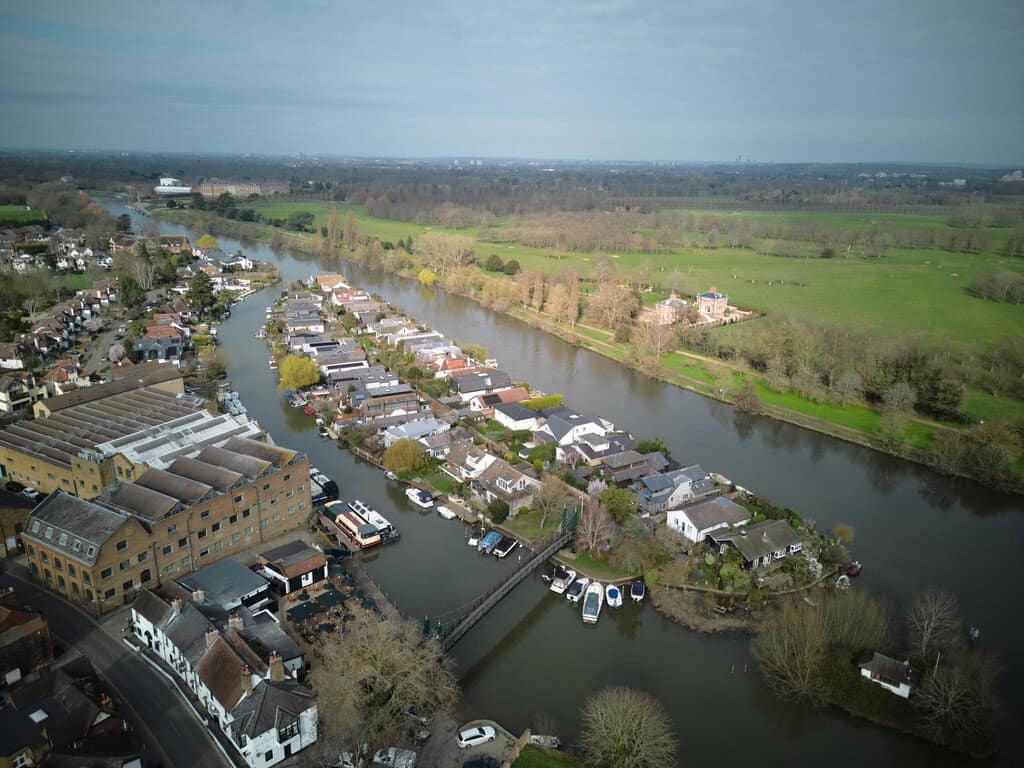
A marina berth is the most straightforward option: a managed site with facilities, usually the easiest to verify and finance around, though rarely the cheapest. A private landowner mooring sits on land owned by an individual rather than a marina operator, and terms vary enormously depending on that landowner’s own arrangements; some have been handed down through the same family for decades and only come up when circumstances change. An end-of-garden mooring belongs to a riverside house and typically transfers with the property rather than being sold separately, which is one reason riverside houses with an existing mooring command a premium over otherwise identical properties without one. And island moorings serve the island homes covered in our island living guide, often tied to informal community arrangements rather than a commercial contract, since most islands have no marina operator to formalise things.
Why Does Residential Status Matter So Much?
This is the distinction that decides almost everything else. A residential mooring is one confirmed as either a pied-à-terre arrangement or a council-tax-paying residential berth, and only this status supports living aboard full-time. A leisure mooring, by contrast, is licensed for recreational use only, and living aboard one, even informally, can put a buyer in breach of the mooring agreement with no legal protection if the landowner or marina decides to enforce it. Getting this wrong is the single most common and most expensive mistake we see buyers make.
What Does a Residential Mooring Cost in 2026?
A residential mooring for a 60ft boat in the London and South East area typically runs £8,000–£14,000 a year. Thames long-term moorings more broadly span roughly £2,000 to £15,000 or more annually depending on location and lease terms. On top of the mooring fee, most residential berths carry council tax in Band A, usually £1,200–£1,500 a year. The Environment Agency has confirmed there’ll be no increase to Thames lock mooring charges for April 2026 through March 2027, which at least removes one variable from the budgeting.
How Do Moorings Actually Change Hands?
Rarely by advertisement. Most residential moorings move through personal agreements between a landowner and a boat owner, and they’re rarely assignable automatically to a new buyer. A change of boat owner doesn’t guarantee the mooring transfers with it, whatever the seller might imply. This is the core of the “network problem”: the moorings that exist mostly aren’t listed anywhere a buyer would think to look, and the people who control them tend to work through relationships built over years rather than open marketing.
How Long Does Finding a Mooring Actually Take?
Longer than most buyers expect, and longer than finding the boat itself in most cases. Where a mooring comes through open channels, such as a marina waiting list, it can take months rather than weeks, simply because turnover is so low. Where a mooring comes through a private landowner relationship, timing depends entirely on when that particular arrangement becomes available, which is precisely why starting the search before you’ve committed to a specific boat tends to work out better than the other way round.
How Do We Help Clients Source a Mooring?
Over four decades in this trade, we’ve built relationships with boatyards, slipways, dry docks, marine surveyors, boatbuilders and mooring landowners along this stretch of the Thames, and we use that network directly to help clients find residential moorings that never reach public advertising. It’s one of the services that sets a specialist riverside agent apart from a generalist one, and it’s often the difference between a buyer finding somewhere to live and a buyer owning a boat with nowhere legal to put it. We’d rather have that conversation early, before an offer’s gone in on a boat, than try to solve it under pressure afterwards.
What Red Flags Should You Watch For?
- An unwritten mooring agreement, or one that only exists as a verbal understanding from a previous owner.
- A leisure mooring being marketed or implied as suitable for residential use: check the actual status, not the seller’s description of it.
- Vague or short lease terms with no clarity on renewal or transferability.
- A landowner or marina who won’t put the transfer terms in writing before you commit to buying the boat.
Any of these should slow a purchase down until they’re resolved in writing, not after completion. None of them are reasons to walk away automatically, but each one needs a straight answer before money changes hands.
If you’re weighing up a specific boat and want the mooring question settled alongside the vessel survey, our due-diligence checklist for buying a floating home covers both together. If you’re still at the stage of finding a mooring itself, call us on 01784 557898 to talk through what we currently have access to through our network, or browse current floating homes for sale where a mooring is already included. You can also get in touch if you’d rather discuss it by email first.
Frequently asked questions
What is a residential mooring?
A residential mooring is one confirmed as suitable for full-time living, either on a pied-à-terre basis or as a council-tax-paying residential berth. This differs from a leisure mooring, which is licensed for recreational use only.
How much does a Thames mooring cost?
As of 2026, a residential mooring for a 60ft boat in the London and South East area typically costs £8,000 to £14,000 a year, with Thames long-term moorings more broadly ranging from around £2,000 to £15,000 or more depending on location.
Can a mooring be transferred when buying a boat?
Not automatically. Mooring agreements are personal to the holder and are rarely assignable, so a change of boat ownership does not guarantee the mooring transfers. Any transfer needs to be confirmed with the landowner in writing before purchase.
About the author
Robert King has spent 41 years in the property industry, most of it working with buyers and sellers in Surrey – Staines and Shepperton – and the surrounding Thames villages. He spent many years living on one of the Shepperton islands with his family, and now lives on the river in Staines. With a passion for water living, he holds an ICC (International Certificate of Competence) for driving leisure craft. Get in touch on 01784 557898 or info@absolute-homes.co.uk.